Showing posts with label St. Anthony of Desert. Show all posts

Saturday, January 15, 2022

Catholic Christian Mystic Hermit: The First Hermit

Well, he is considered to be the first hermit, or called thus.  

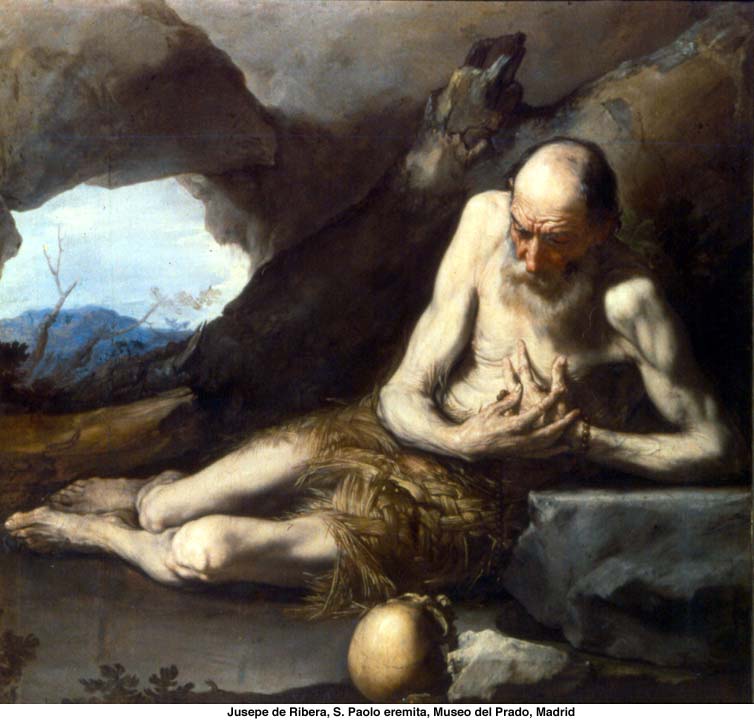
St. Paul is his name.  Born in upper Egypt around 230, he became an orphan when fifteen.  Very rich and well educated, Paul was concerned his riches and education along with Christian beliefs might bring tortures and persecution, endangering his faith, he moved to a remote village. However, his pagan brother-in-law denounced Paul; he next went into the desert trusting God for all his needs.

Paul's faith and confidence in God's providence was rewarded with finding a cavern with a palm tree which provided food, leaves he could weave into clothing of sorts, and a spring with water safe for drinking.  His plan was to return to the world when persecution was over, but already the joys found in prayer and a simple and penitential life caused him to remain of his own choice for 90 years.

 Anthony became aware of Paul due to God's revelation.  Anthony was himself then in the desert living a hermit life (years after Paul had done so), and Anthony spent the next three days seeking Paul.  When Anthony saw a female wolf slip through some rocks, he followed figuring the wolf was going to a water source. That was how Anthony found and met Paul, much his elder.  However, they recognized one another such as souls do who God desires each to know the other's mind, heart, and soul as if friends already.  The two praised God in the joy of meeting.

Along with Anthony finding Paul, a raven brought a loaf of bread.  Paul, it is written, exclaimed, "See how good God is!   For sixty years this bird has brought me half a loaf every day; now thou art come.  Christ has doubled the provision for His servants."  The men then spent the night in prayer; at dawn, Paul told Anthony that he, Paul was soon to die and asked if Anthony would bury him in a cloak given Anthony by St. Athanasius.  Antony left to retrieve the cloak, but on the way back to Paul's cavern, hidden all those decades, Anthony saw Paul rise to heave in glory.  He found Paul's body kneeling as if in prayer, with two lions digging his grave.


We have no idea if a raven truly brought the half loaf of bread all those years or if two lions were digging his grave; but all things are possible in God.  I tend to trust that the account is possible and likely; more unusual phenomenon are known, as God performs miracles of His choosing.  I do find it fascinating that so many people think Anthony is the first hermit known, and I also marvel that people yet do not grasp the simple way of the hermit vocation, and that human-made laws, rituals, and regulations are required for one to be a hermit consecrated by God. 

And, as we see from the various hermits such as Paul and Anthony, the Church is quite accepting of and pleased with these and all hermits for it is not a vocation taken lightly and is not easy to live out over time, perhaps especially in our times with the responsibilities that are required of us as citizens and no deserts in which we can live without paying for the land and property taxes, and meeting the civil laws which govern us today.  


No squatters allowed now, in other words, so our hermit existences must be creatively undertaken in order to have the solitude and silence to pray and listen to God, to praise Him and strive to follow Jesus' life and teachings through immersing ourselves in His Living Word, and to be host or hostess to His Real Presence in a manner deep within while being mostly a hermit within and hidden from others interiorly--not showing ourselves as different or stereotypically "hermit." 


I realize there had been a woman writing repeatedly for years that to live the hermit life one must be approved by a bishop and be called a canonical or diocese hermit, and follow the increasing amount of humankind fairly recently, made up rules and regulations.  I noticed today that a year or two have passed since seeing that blog.  Her writing and thoughts are yet consumed with the created canon law and of the temporal created rules, of who can and who cannot be a hermit, and excludes those such as the first hermit in doing so, as well as hermits throughout Christendom.  I used to waste time countering, explaining the logic and truth of what the Church states, but also and more importantly what God deems and has allowed throughout history from the times of the prophets through John the Baptist on on including our times.


A true hermit over time evolves and grows spiritually.  The relationship with God and the adherence and maturation in God's law --the Law of Love--and the immersion in His Living Word would begin to show fruit of a prayerful, spiritual, loving, mystical nature.  One would not continue to be self-promoting as an authority of a man-made canon law nor adding to it, nit-picking at dioceses who take it further or not far enough per that person's opinions.  Rather, any such so-called hermit would have found work farther from the temporal, not surrounded by people, ceased the socializing and worldy hobbies lovely though they be.  There would be a maturation in His Real Presence that exudes love of others and not love of canon laws and self-promotion as some authority on various temporal Catholic world topics.

So we may have canonically approved hermits in our times, and we also have a host of atrocious wrongs in a church not readily recognizable as Christ's simple yet profound teachings and call to God's law of Love--love of God and love of others as God loves.  Christ's call to follow Him, to abide in Him and His promise of abiding in us--to seek and find Him in His Word and in our minds, hearts, and souls and to find Him in our fellow man, as well, those who are His Children and with a loving recognition such as Paul and Anthony experienced, 

Those few who are given a call to hermit life and vocation--are they a hermit in the fabric and pith of Paul and Anthony?  Time will tell, and only God knows for sure, as only God can be trusted to judge bodies, minds, hearts, and souls.  The fruit in past hermits gives us guidelines by noticing their lives lived--not any canon law for there were none, not any years of repetitive obsessing over who is and who is not a hermit based on some created church law centuries after Jesus instituted His church, never Himself speaking of laws positively except the Law of God which is the Law of Love.  All other church laws Jesus pointed out as hypocrisies and missing the point of God Himself, thus Jesus' teachings and purpose to live on this earth to help us see more clearly as live our lives more dearly in His Real Presence, as His children, in imitation of Christ's life and love.


To be a hermit of God, and in so doing also a Catholic hermit, a Christian hermit, follow the greatest hermits of all time, such as St. Paul, the First Hermit. Live your hermit life consecrated by God above all, and follow the wise words written by humankind in the Catechism of the Catholic Church if you feel you need more than what God will provide and unfold through getting to know these holy hermits of Christian history.  Pray, remain in His Real Presence, live by His Word, the Holy Scriptures.  Go into your cell--the desert and yea the desert of your mind and heart.  Let His Real Presence teach you in your soul.  Plan on decades, not months or years.  The Holy Trinity will teach you and sanctify you.  In Him you are consecrated a hermit of God Is Love, forever, and on this temporal plane.


I place myself in the crucible, to review my life and my hermit vocation.  Am I merging slowly into that of John the Baptist's hermit life, or Paul the First Hermit's life in it's meaning and depth, it's prayer and penitential existence, its focus on His Living Word and God's Law of Love?  Is my life increasingly removed physically from the temporal world yet increasingly praying for that world?  Am I seeking and embracing humility, dying to self, not self-promoting or giving myself made up ecclesial titles of which Jesus would find silly and prideful?  Am I noisy within myself?  

Do I trick myself into thinking I need social contacts in order to have "balance," or do I trust in God's providence to provide whatever human interactions needed--which ironically have become medical appointments now and then errands and their in-passing interactions.  Is the pet a gift from God to learn some needed virtues or a signal of some weakness?  Am I learning to be receptive, not reaching out but waiting for those who have a need or desire to make contact?  If so, am I being a good listener and not over-talking? These are questions to ask of Jesus, and to make adjustments accordingly.

Do I love His Real Presence--Father, Son, and Holy Ghost--more than self and anything other--love God with all my heart, mind, strength and soul and others as God loves?

Am I a Paul or an Anthony hermit, or one of the growing number of canon law type hermits who seem to want to be noticed in habits and as authorities or to create their own orders or guest houses from donations and not by the work of their hands?


St.Paul is a marvelous, holy, humble and deeply spiritual exemplar of Christ abiding in a human and of a human always and ever in His Real Presence.  Paul, please pray for me that I can learn from you, a holy, humble, simple, and simply: hermit--body, mind, heart, and soul of Christ!
Friday, January 17, 2020

Catholic Hermit: Feast of St. Anthony, Abbott


St. Anthony of the Desert, or St. Anthony Patriarch of Monks, or St. Anthony, Abbot--as one and the same man is known, is also known as a hermit.  While he was a hermit for a time period, he is not actually the first Christian hermit (St. Paul of Thebes has this distinction), St. Anthony did not remain in strict terms, a hermit, but more is noted as the father of monks or as abbot (of which St. Benedict who came a couple centuries later, is sometimes inaccurately considered father of monasticism).

However, we come to grasp that designations and distinctions can vary and ultimate, not matter as much as the Christian and holy examples people provide to humanity, through the ages.  And there are, indeed, tendencies, vocations, sometimes more than one vocation or as we might today say "morphed" from one vocation into another or two or three or more vocations, and combinations thereof.

Thus, St. Anthony did live the life of a Christian hermit, one of asceticism and austerity, living the three evangelical counsels of poverty, chastity, and obedience (to God, to the example of Jesus and Scriptures), and for a good portion of time lived in exclusive silence of solitude.

However, upon examining the biography of Anthony by St. Athanaseus and of other commentaries of this holy man's life, we discover details and realities as to the aspects of his hermit portion of life, and then of how God utilized him more as an abbot and monk rather than, per se, hermit.  St. Anthony evolved as a religious solitary, as a hermit, and then more into the guidance and leadership aspects of a monk and leader of monks:  an abbot.  He evolved according to the Lord's will.  This is what following the Lord's will and of dying to ourselves entails; we flow with God's plan for us, not knowing with human certainty what the next present moment may bring.

Thus, we generally do not find St. Anthony being called St. Anthony the Hermit. We Catholic hermits in the consecrated life of the Church and all the Christian hermits over the past 17 centuries, benefit and learn from St. Anthony.  We discover much good as to Anthony's insights and inspirations of the Holy Spirit--of his holy desire and God's will and allowance.  Like St. Anthony, we benefit not only from his eremitic life but also from other religious solitaries who have evolved in living eremitic life.  These holy souls practiced what we call the eremitic vocation, yet remained open to the evolving nature of God's will for every uniquely and individually created human soul--and of that soul's life (hermit and otherwise).

As to Anthony, he desired as well as felt the nudge of the Holy Spirit to remove himself further from the "world" both physically and spiritually.  In order to discern and test that inner impartation, he departed for the desert--away from those who knew him in his locale--although he had been striving to that point increasingly, the silence of solitude, and had given up his possessions.  In thus manner, Anthony spent several years--some indicate 20 years total--between his eremitic beginnings and evolving to that of a far more, austere solitude; and with the austerity within the increasing solitude, some might mistakenly view such extreme solitude and call it:  isolation.

(Of course, "isolation" is strictly a temporal view or usage of the term, for Christians, even consecrated hermits, are never isolated no matter what; His Real Presence and all the holy ones who have gone before, are ever present with the hermit even if not recognizable by the external senses.  We Christian, avowed and professed Catholic hermits are always and ever very much part of the Body of Christ.  To use the term "isolation" as if some sort of negative or unhealthy "wrong" regarding the hermit life and vocation, may be a spiritually inexperienced connotation of "isolation" which denies the very reality of such hermits as living, eternal souls.  We hermits are Christian persons, existing as part and parcel of all others living and deceased ,yet alive within the Consecrated life of the Church.  We are Christian (and Catholic) hermits who exist immortal within the Body of Christ, and very much also part of the Family of Mankind.)

This brief biography best describes in clarity and continuity an overview of St. Anthony's life, lived between 251-356 A.D.)  We can read for ourselves the reality of how Anthony discerned the inspirations of the Holy Spirit and made the decision to follow Christ in the way he did: becoming a hermit and evolving into increasing austerity.  [Here note that no human, not hermit nor bishop, authorized or approved or designated Anthony as a hermit; only could or does the Three Persons of the Holy Trinity truly bless and consecrate such souls in their vocation/s.]

After those two approximate two decades of deepening hermit life, Anthony (God's will be done) then evolved into that of a teacher and leader of monks, later given the title of Abbot--and Patriarch of Monks--and considered to be an early founder of monasticism.  And as we read in the following bibliographical commentary of his life, Anthony was in the last part of his life, called to return once more to that stricter separation from the world that is one of several marks of the eremitic vocation.

So it was that Anthony, much later in life, having been essentially called out of extreme solitude of hermit life to be abbot and guide of vast numbers of monks, St. Anthony again returned once more to the stricter separation from the world of monasticism, from leading and teaching and of being an abbot to those many who desired instruction in the spiritual life much as Anthony had desired years prior when beseeching the hermit he knew to teach him the spiritual life.  Anthony returned to his eremitic life, and lived out his remaining years on earth as such, removed from others and in more austerity and asceticism, hidden from the eyes of men, and in praise of God and prayer for the world.

"St. Anthony was born in the year 251, in upper Egypt.  Not long after his parents died, Anthony hearing at Mass the words, 'If thou wilt be perfect, go, sell what thou hast, and give to the poor,' he gave away all his inherited possessions.  He then begged an aged hermit to teach him the spiritual life. [Note here that Anthony did not ask to be taught the hermit vocation, nor to receive approbation or authorization to be a hermit; he wanted to learn the spiritual life.]  He also visited various solitaries, copying in himself the principal virtue of each.

"To serve God more perfectly, Anthony entered the desert and immured himself in a ruin, building up the door so that none could enter.  Here the devils assaulted him most furiously, appearing as various monsters, and even wounding him severely; but his courage never failed, and he overcame them all by confidence in God and by the sign of the cross.

"One night, whilst Anthony was in his solitude, many devils scourged him so terribly that he lay as if dead.  A friend [was not at that point without friends checking in] found him thus, and believing him dead, carried him home.  But when Anthony came to himself he persuaded his friend to carry him, in spite of his wounds, back to his solitude.  Here, prostrate from weakness, he defied the devils, saying, 'I fear you not; you cannot separate me from the love of Christ.'  After more vain assaults, the devils fled, and Christ appeared to Anthony in glory.

"His only food was bread and water, which he never tasted before sunset, and sometimes only once in two, three, or four days.  He wore sackcloth and sheepskin, and he often knelt in prayer from sunset to sunrise.

"Many souls flocked to him for advice, and after twenty years of solitude, he consented to guide them in holiness--thus founding the first monastery.  His numerous miracles attracted such multitudes that he fled again into solitude; where he lived by manual labor.

"He expired peacefully at a very advanced age.  St. Athanasius, his biographer, says that the mere knowledge of how St. Anthony lived is a good guide to virtue."


God bless His Real Presence in us!  Little children, let us love God in Himself and love others as God loves!

\

Thursday, November 13, 2014

Braving, Battling Birds and Demons


There is a prize for anyone who can figure out where birds get into this hermitage!  Another one greeted this morning.  Perhaps it is the Lord reminding that He cares about the sparrow and certainly cares about us!  Not sure if the little sparrow is outside or not.  Have opened windows and doors, but then it tends to pop up in another area, yet inside.  So be it, little bird.

It has been 44 degrees inside here, and that with the heat pump going non-stop.  Yes, it finally got repaired only to have another power outage.  But this time when the power came back on after a few hours (cold ones, huddled in bed), the circuit board had not blown, thankfully.  It is just very cold.  The heat pump man came when called, and the heater is pumping out heat.  He thinks more insulation will help, and "button up the place."

There is nothing like physical discomfort to be either a motivating factor or a death-knell.  For this nothing Catholic hermit, it is a motivating factor for now.  Hustled as much as a cold, old, pained hermit can hustle, and got more insulation in the wall spaces.  

But it is not as easy as it may sound.  First all the rat feces, remains of nests, and cobwebs are to be swept from between studs.  Then steel wool is jammed down in crevices through which critters can squeeze themselves, amazingly squeeze themselves to find warmth.  Perhaps the cold in here is helping them not desire coming in so much?

Each piece of insulation is cut-to-fit the stud spaces of which no two are the same dimensions in this old domicile.  Woke up in the middle of the night to pain and also to the immediate thought:  Have to remove the insulation between all the studs and toe-nail in 2x4 blocks along the floor line.  Yes.  Surely my angel or some carpentry contractor in purgatory was sent to remind that one must have wood along the floor between studs to which the drywall and baseboards can be screwed and nailed.  

Most construction has what is called a base or toe-plate, a 2x4 that comprises the bottom of a wall.  the wall studs are nailed to the base plate and also to a top plate or ledger plate.  This old farmhouse simply has wall studs that run from the crawlspace to the top or ledger plate at roof.  The studs are 20' long and probably milled at an old lumber yard, early 1900's.

There is work to be done, and the bird of this morning is still not outside.  Saw him fluttering about in the next room.  Opened that window, but it flew downstairs.  Will deal with him later (a him due to the brighter feather coloring).  And will deal with removing insulation and nailing in the wood between studs once the body gets energized and focused enough to tackle the cold downstairs and outside where the power saw is upon its stand.

As to demons, have been battling them, and not as bravely as one would hope.  They attacked Saturday night and did not leave until Sunday night.  This hermit is sick and tired of the annoying spirits, inserting such dark thoughts into the mind and playing upon physical pain and weariness and emotional fatigue.  So decided to defrock the demons, so to speak.  Shame them out, shine the light on them, and enlist a couple of close spiritual friends to pray for this hermit in the thick of battle.

Just put it in writing to the friends, what are the dark thoughts, and how am tired of waking up to them in the wee hours, or having them descend with the dusk.  There is power in prayer; and there is power in laying bare the ugly thoughts that gain victory over us when we keep them held in.  Called the electrician, and said how overwhelmed in here with the cold and the discomforts, the work to be done and the dwindling funds.

He said anyone would be discouraged and overwhelmed with this place!  He said men would be, and men who were able-bodied, at that.  Told him how the other day decided to use the hammer he'd forgotten the last time he was here.  Laughed and said was used as a show of force and strength to get some work done! 

The main thing is to trust the Lord and simply keep going.  One must brave the elements and battle the demons.  Both are aspects of the eremitic life and tradition that are nothing new. 
_________________

A friend sent a video that helped with fortitude and  with outing and routing the demons.  It was of a man who'd been atheist for 44 years and then converted to Coptic (Eastern Orthodox) monk.  He exudes humility in the video as he shares his challenges, of which a main one is the human loneliness and sense of isolation. 

Yes, of course he has God with him; but he mentioned the other monks were in their own culture, had their language, and their families who would visit now and then.  He does not speak their tongue; he has no immediate family living, and if so would be on the other side of the world.  This hermit put it in a fascinating context.  He said the other monks have it much harder because they deal with the demons of the senses as distractions.  They can converse, they can hear and understand, they are reminded of the world in these ways, plus through their family members who are alive and not far away.  

These distractions are needling attachments and cause the other hermit monks more difficulty in arriving at the inner attachments that then need to be revealed and removed.  So, despite how difficult it is for the hermit who is of a different culture and country, he considers himself blessed to have the outer attachments snipped by circumstances. 

Hearing the hermit monk speak of such loneliness and sense of isolation helped this nothing Catholic hermit immensely.  Instead of the challenges here being hardships, or the inner battles being somehow a signal of something wrong or the vocation a failure, it all made sense that all this is a gift.  Being stripped of much human interaction, being in such solitude, braving the elements and battling the demons are signs of progress in the spiritual life and in this eremitic vocation.

The hermit monk also mentioned some phases or categories of which St. John Climacus discusses in The Ladder of Divine Ascent.  There are three ways of the hermit monk.  The first is living in community in a monastery with people about and some level of interactions.  The second is living with two or three others.  The third is living in solitude.  The man in the video lived in solitude whereas others in his community lived in the monastery.


While examples could be given of the shifts God provides in hermit lives, with some living among others more than those living with just two or three, and yet other hermits living in relative isolation from people whether religious or not, God determines each hermit's course--and most often uses circumstances to let the hermit know his or her course.

For the hermit in the video, his mother's death was a factor, as well as a conversion experience while he was traveling the world.  How he ended up in the desert and as one of the monks associated with the monastery built where St. Anthony of the desert built his hut in the 3rd century, was not revealed in the video.  He was there, though, and had been a hermit monk for some years, and was of the solitary type of hermits (of the three general ways).

What impresses, though, is the hermit's humility in candor about his struggles and challenges (at the time of video being filmed).  While he faced mostly inner challenges, still, he said, memories could snag him the most and tempt him to think of external distractions.  When the other monks families visit, he knew they talked with each other; or at other times the monks talked among themselves.  He could feel very alone.  Then, God would remind him that the hermit was with Him, and that the sense of isolation provided God to fill the hermit in ways no other could.

It is true; it is so.  There is purpose for hermits who God takes along the path of stricter, perhaps strictest, separation from the world in silence and solitude, for greater praise of God and in prayer and penance.  Whatever the case for each hermit, we ought be thankful for whatever way God provides.

__________________

Now to go downstairs and into the cold, and try to help the little bird find its way through the door which the hermit shall open for it.  And then, bundle more and measure, cut, and nail some 2x4's.  Praise God for His providence in courage to brave and battle the birds and the demons!  

God bless His Real Presence in us!  Little children, let us love one another (and all creatures) for God is Love!  Remain in His Love!

[As was finishing sharing, that little sparrow perched above on a coiled wire hanging from the ceiling.  Opened yet another window, but it disappeared in a hole in a wall in the other room.  Aha!  That is its little hermitage within this hermitage.  Eventually that wall will be gutted, and hopefully the bird will have flown out a window before more cold in here.  

"Are not two sparrows sold for a penny? Yet not one of them will fall to the ground outside your Father’s care.  And even the very hairs of your head are all numbered.  So don’t be afraid; you are worth more than many sparrows" Matthew 10:29-31.]